
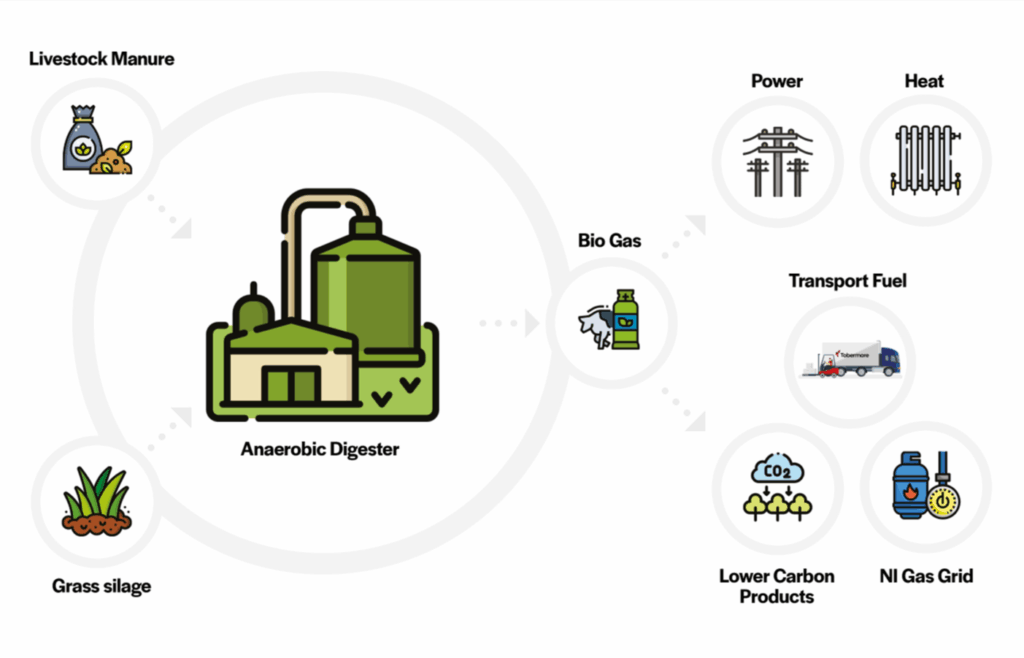
The UNZIP project set out to explore how a group of major Mid Ulster manufacturers could work together to cut carbon emissions, and how agriculture—often overlooked in Northern Ireland’s climate plans—could play a central role in this transition. Agriculture naturally captures CO₂ through plant growth, and the project investigated how farm residues such as livestock slurry could be transformed into valuable low‑carbon products and clean energy.
Working with companies including CEMCOR, Tobermore, Dale Farm and RSC Group, researchers examined how these industries could replace fossil fuels with locally produced biomethane, generated through anaerobic digestion (AD) and supported by a new large‑scale biorefinery. A detailed mass and energy assessment showed that a 10 MW biorefinery could process around 300,000 tonnes of agricultural material each year, producing renewable gas, biochar and nutrient‑rich fertilisers.
The project also demonstrated wider benefits. Biochar produced from digestate could help decarbonise cement and concrete, while early trials at Tobermore showed that biomethane‑powered forklifts could successfully replace diesel machines. Engagement with farmers highlighted how slurry processing could improve nutrient management on farms and support new sustainability requirements.
UNZIP helped secure further funding, including a £4m Sustainable Use of Livestock Slurry SBRI award, and progressed detailed feasibility work, site evaluation and planning for a biorefinery at the Cemcor quarry. The project also informed government consultations on biomethane policy and infrastructure needs.
Overall, UNZIP has shown how industry, agriculture and government can collaborate to create clean energy, reduce emissions across multiple sectors, and support new green jobs in Mid Ulster—laying foundations for Northern Ireland’s emerging circular bioeconomy.